

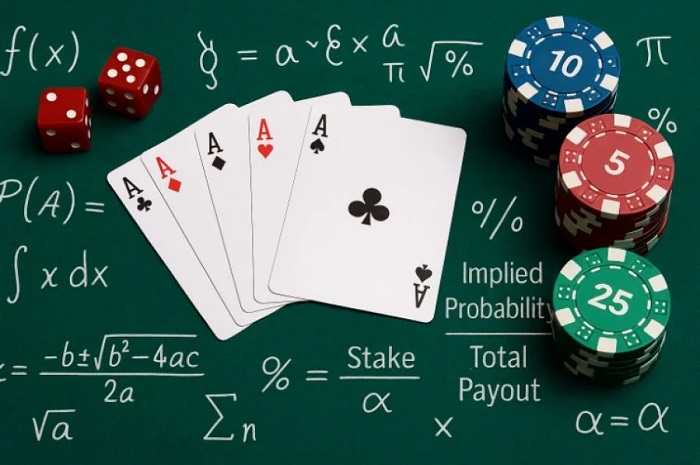
Strip away the dazzling neon lights, the clinking stacks of chips, and the celebratory chimes of a casino floor, and you are left with an environment governed entirely by numbers. Every spin of a wheel, roll of the dice, and shuffle of cards is an exercise in applied mathematics. While marketing narratives frame gambling around luck, destiny, or intuition, the underlying framework is built on rigorous probability theory, discrete mathematics, and financial modeling.
Understanding the mathematical architecture of gaming does not require an advanced degree in statistics. However, grasping a few foundational concepts changes how you see the entire landscape. It pulls back the curtain on the illusion of control, explains why short-term windfalls happen, and reveals why the house inevitably prevails over the long haul.
The Mechanics of House Edge and Expected Value
At the heart of every commercial game lies a mathematical construct known as the house edge. This is not an arbitrary fee or a hidden commission quietly deducted from your balance; it is the built-in mathematical disparity between the true probability of an event occurring and the payout odds offered by the casino.
To see this dynamic in action, consider American roulette. The wheel features 38 pockets: numbers 1 through 36, along with a single zero and a double zero. If you place a straight-up wager on a single number, your true mathematical chance of hitting that pocket is 1 in 38. If the game were mathematically fair—meaning neither side held an advantage—a winning bet would pay out at 37 to 1.
In reality, casinos pay out a winning single-number bet at 35 to 1. That discrepancy of two units is where the operator makes its living. Over thousands of spins, that structural gap creates a permanent statistical advantage of roughly 5.26 percent in favor of the casino.
This brings us to expected value (EV), which measures the average outcome of a wager if it were repeated an infinite number of times under identical conditions. In virtually every standard casino game, the player’s expected value on any given bet is negative. When you place a ten-dollar bet on a game with a five percent house edge, your mathematical expectation is to lose fifty cents per trial. While individual bets end in a clean win or a total loss, the expected value represents the gravitational pull that steadily drains capital over extended sessions.
Independent Events and the Gambler’s Fallacy
One of the most persistent cognitive traps in gaming stems from a misunderstanding of independent probability. In games governed by mechanical or digital randomization—such as roulette wheels, craps dice, and slot machine reels—each trial exists in total isolation. The equipment has no physical memory, no awareness of previous outcomes, and no inherent desire to balance the scales.
When a roulette wheel lands on black seven times consecutively, casual observers often feel an irresistible urge to bet heavily on red. They convince themselves that red is due, reasoning that eight consecutive black outcomes is an anomaly.
This misstep is known as the Gambler’s Fallacy. While the probability of landing eight consecutive black results before the first spin begins is indeed low, the probability of the eighth spin landing on black—given that the first seven already occurred—remains exactly 18 in 38, or 47.37 percent. The previous spins are sunk history. Believing that a machine or a wheel must correct itself confuses overall statistical distribution across vast sample sizes with the absolute randomness of the next individual event.
Dependent Probability and Skill Expression
While games like roulette and slots rely strictly on independent trials, other classic games operate under the rules of dependent probability. Here, past outcomes actively shape future probabilities because items are removed from the available pool without being replaced.
The prime example is blackjack. A standard shoe contains a fixed inventory of cards. As high cards (tens, face cards, and aces) or low cards (twos through sixes) are dealt out and placed in the discard tray, the mathematical composition of the remaining deck shifts dramatically.
A shoe rich in remaining high cards tilts the mathematical advantage toward the player, increasing the frequency of natural blackjacks (which pay a bonus) and raising the likelihood that the dealer will bust on stiff hands. This structural reality gave birth to card counting, an approach that tracks the shifting density of remaining ranks to identify brief windows where the player actually holds a positive expected value.
Even without card counting, blackjack illustrates how mathematical optimization influences outcomes. By adhering strictly to basic strategy—a mathematically verified matrix detailing the single best statistical action for every possible combination of player hand and dealer upcard—a player can shrink the house edge down to roughly 0.5 percent. Deviating from that matrix based on hunches instantly hands that advantage back to the casino.
Poker takes dependent probability a step further by removing the house as a direct opponent. In peer-to-peer card games, players compete against one another, and mathematics becomes a competitive weapon. Successful players calculate pot odds—the ratio of the current size of the pot to the cost of a contemplated call—and compare them directly against the probability of hitting a winning card. When the reward outweighs the risk relative to the true odds, calling is mathematically profitable over the long term, regardless of whether that specific hand wins or loses.
The Law of Large Numbers and the Illusion of Winning
If the mathematics always favors the house, why do people win? The answer lies in the friction between short-term variance and long-term probability, governed by the Law of Large Numbers.
In probability theory, the Law of Large Numbers states that as the number of trials increases, the actual observed result will converge closer and closer to the theoretical expected value.
Over a sample size of twenty roulette spins or fifty blackjack hands, variance—the measure of statistical dispersion or swings—dominates the results. A player can easily hit a blistering streak of good fortune, double their bankroll, and walk away a winner. The casino fully expects and welcomes this. Short-term winners provide authentic marketing and reinforce the idea that anyone can beat the system.
However, the casino is not playing fifty hands. The casino is playing millions of hands across hundreds of tables all year round. Across that immense sample size, individual lucky streaks vanish like drops in the ocean. The variance flattens out, and the actual gross gaming revenue converges with surgical precision onto the theoretical house edge. The house never needs to rely on luck because volume guarantees profitability.
Volatility and the Reality of Bankroll Preservation
Beyond house edge, players must reckon with volatility, often referred to as variance. House edge tells you how much money the casino will retain on average over time; volatility describes the path taken to get there.
A game with low volatility, such as baccarat or the pass line in craps, produces frequent, modest wins and losses. Your bankroll tends to rise and fall in a gentle wave, allowing for extended playtime on a modest budget. Conversely, high-volatility games like modern video slots offer tiny base-game returns interspersed with rare, massive payouts. You can burn through hundreds of wagers with almost nothing to show for it before hitting a significant return.
Understanding volatility is essential for realistic bankroll management. When players wager too high a percentage of their total funds on high-volatility games, their risk of ruin—the mathematical probability of losing the entire bankroll before experiencing a positive upswing—approaches certainty.
Stripping away the myths surrounding gambling leaves you with an unyielding reality: the math is fixed, transparent, and patient. Probability does not bend for emotional convictions, lucky charms, or hopeful betting progressions like Martingale systems. Recognizing these mathematical principles transforms how you interact with games of chance. It replaces false expectations with clear-eyed realism, framing gambling not as a viable method for generating income, but as a calculated form of entertainment with a clearly defined cost of admission.
