

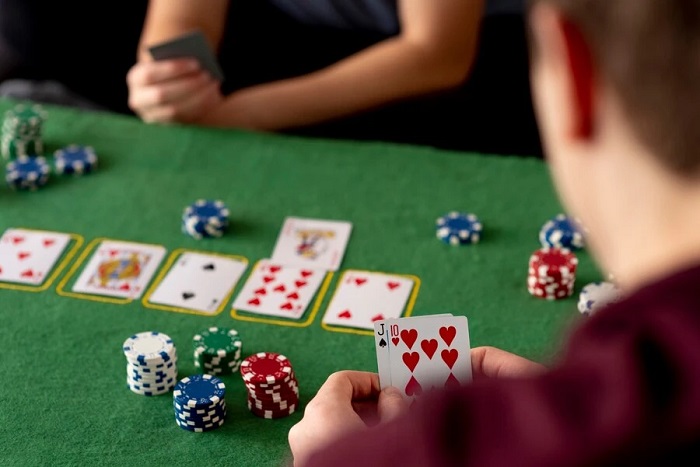
Hollywood has spent decades convincing the public that poker mastery hinges on dramatic physical tells. In movies, a player gives away a monster hand with a twitch of an eye, a trembling hand, or an involuntary glance at their chip stack. While physical mannerisms certainly exist, experienced players know that live reads are rarely that theatrical. Opponents can wear sunglasses, mask their posture, and control their breathing.
What they cannot disguise is where they put their chips. Every check, bet, raise, and call represents a legally binding commitment of capital governed by clear financial incentives. These sequential decisions form betting patterns, and learning to interpret them is the most reliable way to deduce an opponent’s range. Mastering this skill requires shifting your perspective from guessing specific hands to decoding the structural logic behind how players build pots.
Treat Hands as Multi-Street Stories
A common mistake among developing players is treating every street of a hand as an isolated event. They evaluate a river bet based purely on the river card, completely detached from how the action developed on the flop and turn.
Betting patterns are narratives told in four chapters: pre-flop, flop, turn, and river. A player holding an authentic powerhouse usually tells a cohesive story. Their pre-flop aggression leads to an intentional flop bet, sustained turn pressure, and a decisive river value shove. When an opponent’s story features glaring plot holes, you are often looking at a manufactured bluff or a poorly planned bluff-catcher.
Consider an opponent who merely calls a raise pre-flop, checks through a draw-heavy flop, checks an unthreatening turn card, and then abruptly unleashes a massive overbet on an innocuous river blank. If you ask yourself what legitimate hands would logically take that exact path, the answer is usually very few. Strong holdings would have charged drawing hands on earlier streets to protect equity and build the pot. When the pattern contradicts fundamental board texture and player incentives, the narrative falls apart, exposing an attempt to buy a pot they could not win through conventional lines.
Deconstruct Bet Sizing and Range Polarization
Betting patterns are defined just as much by how much a player wagers as whether they wager at all. Bet sizing provides direct insight into how an opponent perceives their own hand strength relative to your range.
The Dynamics of Sizing Tells
Recreational players frequently suffer from inelastic sizing tells, meaning their bet sizes correlate directly with hand strength rather than table strategy. When they flop the absolute nuts, they might bet three-quarters of the pot or more because they want maximum reward. When they are nervous with a marginal second pair, they slide out a small exploratory bet of twenty percent of the pot to “see where they are at.” Identifying these baseline tendencies allows you to gauge absolute hand strength with remarkable precision.
More experienced players employ sizing to polarize or condense their ranges:
-
Small Sizing (25% to 33% of the pot): Often deployed on dry, static boards where the aggressor has an overwhelming range advantage. It forces wide defenses and taxes marginal holdings cheaply without risking much capital.
-
Large Sizing (75% to overpot): Signals polarization. A player betting significantly more than the pot is usually communicating that they hold either the near-nuts or absolute air. They are not betting a medium-strength holding because an overbet only gets called by hands that beat medium strength.
When you face an extreme sizing decision, do not ask yourself if your specific cards are pretty. Ask whether the opponent has enough natural bluff candidates in their pre-flop and flop range to justify an overbetting line on that specific board.
Gauging Target Elasticity
Improving your reads also means observing how an opponent expects you to react to sizing. An elastic player adjusts their calling range based on the price offered, folding more often against large bets. An inelastic player calls or folds based strictly on the absolute value of their own cards, indifferent to whether the bet is one-third pot or double pot. When you notice an opponent repeatedly firing large bets into notoriously stubborn calling stations, that pattern screams genuine value rather than deception.
Map the Geometry of Table Position
A bet placed out of position carries vastly different strategic implications than an identical bet made on the button. Position dictates who closes the action, who holds informational leverage, and how easily a player can control pot growth.
When a player consistently enters pots from early position, their baseline range should naturally skew tighter and stronger. A continuation bet from the under-the-gun raiser into three players carries immense organic weight. Conversely, a button open followed by a continuation bet into the big blind represents a wide, opportunistic range that includes numerous speculative hands.
Pay special attention to line deviations based on position, such as check-raising from the blinds. Check-raising out of position requires significant conviction because the player surrenders the opportunity to set the price and commits to playing a ballooning pot without positional advantage. When a passive opponent suddenly deviates from their routine check-call habit to deliver a check-raise on a coordinated turn card, taking that show of strength at face value will save you countless chips.
Audit Timing Cadences and Hesitation Cues
While timing is technically a physical factor, it is inextricably tied to betting mechanics. The speed at which a player executes an action often reveals whether they had a plan in advance or were forced to improvise under unexpected pressure.
Instant decisions usually reflect a pre-determined strategy. An immediate check from a player out of position typically indicates weakness, showing they gave up on the hand before the card even hit the felt. An instant call on a wet board frequently points to a draw; the player knew their exact mathematical price to see the next card and did not need to deliberate over equity.
The most informative timing shifts occur when an opponent is jolted out of their comfort zone:
-
The Long Deliberation Followed by a Raise: Often a sign of calculated aggression. True novices may fake hesitation to disguise a monster hand, but thinking players who take extra time before raising are usually working through the mathematics of a high-equity bluff or weighing value thresholds against your specific distribution.
-
The Abrupt Snap-Raise: In recreational settings, an explosive, unhesitating raise almost universally represents extreme, unambiguous strength. Players rarely construct complex bluffs in a fraction of a second without deep consideration.
Build a Discipline of Showdown Auditing
You cannot sharpen your ability to read betting patterns if you stop paying attention the moment your own cards hit the muck. The most valuable information at any poker table is delivered during hands you were not involved in.
Whenever two opponents reach a showdown, use that moment to perform an immediate post-mortem audit. Rewind the hand mentally from the moment the hole cards are exposed back to the pre-flop action:
-
Did the winner raise three times the big blind with suited connectors or high broadways?
-
How did they size their flop bet when they held a flush draw versus top pair?
-
Did they slow-play a set on the turn, or did they aggressively build the pot?
By systematically matching revealed hole cards back to the exact wagers that led up to them, you assemble a personalized behavioral profile for every opponent at the table. Over a few orbits, random bets stop looking like white noise and begin coalescing into predictable, exploitable habits.
Reading betting patterns is ultimately about training your mind to seek logical coherence in an environment defined by incomplete information. By tracking the multi-street narrative, analyzing sizing choices, factoring in positional leverage, and diligently studying every showdown, you demystify your opponents’ intentions. You stop guessing what they hold and start anticipating precisely how their patterns will unfold.
