

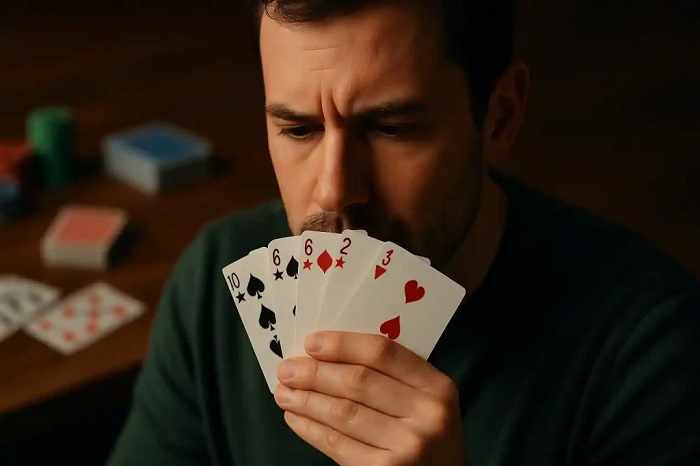
Most casual players view a dealt hand through the lens of pure chance. When cards run cold, they blame bad luck; when a favorable river card lands or a vital trump card appears, they celebrate good fortune. Yet sit across from veteran card players in any discipline—whether it is high-stakes poker, duplicate bridge, competitive rummy, or collectible card games—and that illusion of randomness quickly falls apart.
Card games are, at their core, dynamic exercises in decision-making under conditions of incomplete information. While luck dictates the initial distribution of cards, long-term success belongs entirely to players who systematically minimize risk and exploit subtle advantages. Transforming from an average card player into a formidable competitor requires cultivating a specific toolkit of cognitive, mathematical, and emotional skills.
Deductive Reasoning and Information Tracking
In games like chess, both players see the entire board at all times. Card games operate on the exact opposite principle. The most critical pieces of data are deliberately hidden, tucked away in an opponent’s hand or buried face-down in the draw pile.
Superior players treat every action at the table as a clue. If a bridge partner leads with a specific suit, if a gin rummy opponent discards a middle card rather than an obvious high-point liability, or if a poker player checks on a wet board, that action reveals concrete information. Deductive reasoning bridges the gap between what is visible and what is hidden.
Developing this skill requires active card counting and memory discipline. It is not enough to look only at the cards currently resting in your own hand. You must track which cards have already been played, which suits remain live, and what discards your opponents have intentionally passed over. By continuously eliminating impossible scenarios, you narrow down the universe of potential holdings until an opponent’s hidden hand becomes almost entirely transparent.
Probabilistic Thinking and Calculating Expected Value
Intuition has its place, but players who rely solely on gut feelings invariably bleed chips or points over time. Card mastery demands a working comfort with basic probability, combinatorics, and risk assessment.
Every strategic decision carries an inherent mathematical trade-off known as expected value. A play with positive expected value will generate profitable returns if repeated a thousand times, even if it fails on any single occasion. Conversely, making a play with negative expected value is fundamentally flawed, regardless of whether a lucky draw bails you out in the moment.
Separating Process from Outcome
One of the steepest learning curves for developing players is shedding results-oriented thinking. In a game governed by variance, you can execute a mathematically flawless strategy and still lose the hand. Similarly, an opponent can make an objectively terrible play and walk away with the pot.
Mastering card games requires detaching your ego from individual results. Great players judge their performance purely by the quality of their choices rather than the immediate outcome. When you evaluate hands through the lens of proper odds and sound logic, temporary bad beats lose their sting, allowing you to maintain structural discipline through inevitable downswings.
Emotional Regulation and Tilt Control
Technical brilliance means very little if your mental composure shatters the moment adversity strikes. In gaming terminology, “tilt” describes the state of emotional frustration that causes a player to abandon optimal strategy in favor of erratic, aggressive, or desperate maneuvers.
Tilt rarely announces itself with dramatic outbursts. More often, it creeps in subtly: calling a bet you know you should fold, playing speculative starting cards out of sheer boredom, or pressing an advantage too quickly to win back recent losses.
Top-tier players practice rigorous emotional detachment. They recognize physiological warning signs—such as a quickening pulse or a tightening jaw—and deploy conscious mental resets to stay grounded. Patience is an active offensive weapon. Sitting through extended dry spells without forcing bad action is often what preserves your stack long enough to capitalize when the odds finally tilt back in your favor.
Pattern Recognition and Opponent Profiling
While mathematics provides the baseline strategy, human psychology dictates how that strategy should be adjusted in real time. No card game is played in a theoretical vacuum; every opponent brings personal biases, tendencies, and predictable habits to the table.
Sharpening your observational skills allows you to identify player archetypes quickly. Some opponents play overly timid styles, folding to any sign of strength and betting only when holding near-unbeatable hands. Others play hyper-aggressively, relying on sheer pressure to force mistakes.
Beyond structural playstyles, careful observation uncovers behavioral timing and physical tendencies. A hesitation before an action, a sudden change in posture, or an irregular pattern of bet sizing often signals the true strength of a hand far more accurately than facial expressions.
Fluid Tactical Adaptation
Categorizing an opponent is only the first step; the real skill lies in tailoring your strategy to exploit their specific flaws. Playing a rigid, textbook game makes you predictable. Against an overly cautious opponent, you should widen your range and apply relentless pressure through well-timed bluffs. Against a wild, reckless player, the optimal adjustment is to tighten your requirements, abandon fancy deceptive plays, and let them pay off your strong holdings.
Resource and Bankroll Management
Every card game revolves around managing finite resources. In poker, that resource is your chip stack and overall bankroll. In trick-taking games, it is your distribution of high-value trumps. In modern collectible deck-builders, it is your action economy and card-draw engine.
Poor resource management turns small mistakes into fatal errors. If you commit too much of your capital early in a hand without securing a decisive advantage, you leave yourself vulnerable to sudden counterattacks.
Outside the immediate game, bankroll management serves as your primary survival mechanism. Even elite players experience extended statistical anomalies where mathematically sound choices fail repeatedly. Having the discipline to play at stakes appropriate for your financial cushion guarantees that a temporary stretch of negative variance will never wipe you out entirely.
Great card play is never a matter of secret tricks or mystical intuition. It is a composite discipline built on calculated risks, continuous observation, razor-sharp emotional control, and the patience to let probability do the heavy lifting over time.
