

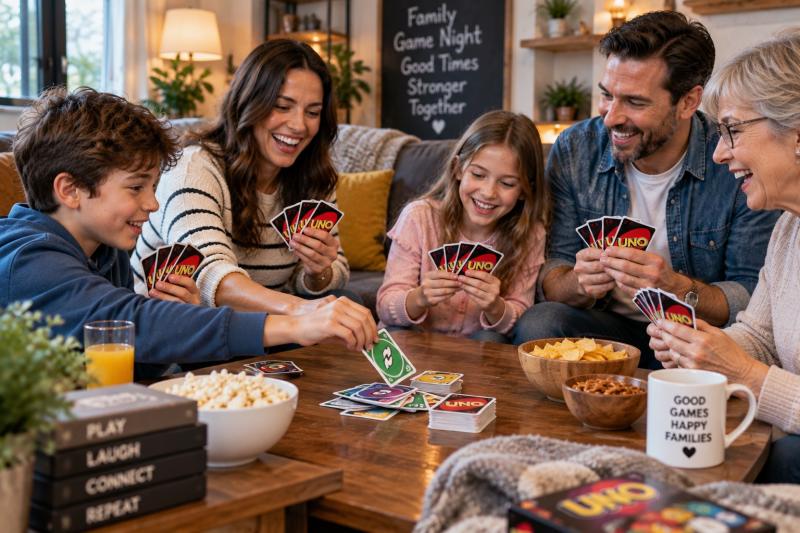
Modern family game nights frequently collapse under the weight of good intentions. A parent buys a critically acclaimed designer board game, only for the evening to stall out during a forty-minute rules explanation featuring punch-out cardboard tokens, miniature plastic figurines, and a rulebook thicker than a small appliance manual. Other households default to video games or digital party apps, trading one set of isolated glowing screens for another.
Tucked into a kitchen drawer, however, sits a far more reliable antidote to evening boredom: an ordinary pack of playing cards. Whether it is a traditional fifty-two-card Bicycle deck or a vibrant box of Uno, card games possess an effortless elegance that high-production board games and digital entertainment rarely replicate. Their simplicity strips away logistical friction, creating an environment where spontaneous connection, friendly competition, and shared laughter can genuinely flourish across generations.
Zero Setup and the Elimination of Friction
The greatest threat to any family tradition is administrative overhead. When an activity demands extensive setup time, sorting hundreds of components, or managing complex board states, enthusiasm wanes before the first move is made. Younger children lose focus, and fatigued parents look at the clock and wonder if the effort is worth the payoff.
Card games bypass setup paralysis entirely. A quick riffle shuffle, a deal around the table, and the round begins in under two minutes.
Because most card formats break down into brief, modular rounds rather than an unbroken multi-hour marathon, they offer unmatched structural flexibility. A family can squeeze in a quick three-round game of Rummy before bedtime on a school night, or settle in for an entire evening of Spades without feeling locked into a rigid commitment. If dinner is ready or a bedtime deadline arrives, finishing the current hand provides a clean, satisfying stopping point.
Bridging the Generational Divide
Finding an activity that genuinely entertains an eight-year-old child, an overworked parent, and an aging grandparent without patronizing anyone is remarkably difficult. Video games often favor youthful hand-eye coordination, while complex trivia games inevitably skew toward adult life experience.
Card games serve as the great equalizer. Their core mechanics—set collection, trick taking, shedding, and matching—are universally intuitive.
Grandparents often carry decades of muscle memory for classic games like Euchre, Hearts, Bridge, or Canasta. When a child learns how to play from an older relative, the dynamic shifts from digital dependency to oral tradition. The child discovers the tactile thrill of sorting a hand by suit and rank, while the grandparent gets to pass along subtle strategic advice. Generational hierarchies dissolve around a card table, leaving everyone to compete on equitable ground.
Cognitive Conditioning Disguised as Play
While families sit down simply to have fun, card games quietly demand and develop a formidable array of mental faculties. Because the learning is embedded directly into the gameplay, children and adults alike exercise cognitive muscles without the stiff formality of homework or brain-training apps.
Mental Math and Working Memory
Tracking cards requires active mental participation. A game of Cribbage turns addition and pegging calculations into an urgent reflex. Games like Gin Rummy or Crazy Eights require players to remember which suits were discarded two turns ago and predict what an opponent might be stockpiling.
For younger players, holding a fan of cards teaches basic categorization, numerical ordering, and pattern recognition. For older adults, this continuous monitoring of discarded values and remaining probabilities provides valuable cognitive stimulation, keeping working memory agile through low-stress repetition.
Probability and Strategic Foresight
Card games are masterclasses in dealing with incomplete information. Unlike games with open boards, half the game exists hidden in opponents’ hands or buried deep within the draw pile.
Children quickly realize that every play carries an opportunity cost. Discarding a high card might clear deadwood from their hand, but it might also hand victory directly to the player to their left. Learning to weigh immediate relief against future risk instills probabilistic thinking and delayed gratification, foundational mental frameworks that extend far beyond the tabletop.
The Conversational Architecture of the Deck
One overlooked strength of card games is the acoustic space they create. Unlike television viewing, which demands silence, or fast-paced video games, which trigger heightened sensory tunnel vision, card games feature a natural conversational cadence.
Hands involve rhythmic lulls. Between shuffling, dealing, and waiting for an opponent to deliberate over a discard, natural pauses appear. These brief pockets of downtime allow family members to trade updates about their week, tell stories, playfully tease one another, or unpack lighthearted grievances. The deck acts as an anchor—it gives nervous hands something to do and breaks awkward silences, yet remains undemanding enough that authentic dialogue takes center stage.
Emotional Resilience in Low-Stakes Encounters
Every card player eventually experiences a bad run of cards. You can execute a mathematically sound line of play in Hearts or Spades and still get completely undone by an unlucky distribution.
This inherent variance makes card games an exceptional sandbox for teaching emotional regulation. Because individual hands are so brief, losing a round does not sting with the devastating weight of losing a two-hour board game. A player learns to accept an unfortunate deal, adjust their expectations, minimize their losses, and wait for the deck to turn.
Navigating those swings teaches sportsmanship in miniature. Children learn that bluffing requires emotional composure, that gloating over an early lead often invites a swift counterattack, and that grace under pressure is more valuable than winning a single trick.
Infinite Variety in a Single Pocket-Sized Box
From an economic perspective, a standard deck of cards represents the highest return on investment in the entire entertainment industry. For a few dollars, a family gains access to hundreds of distinct games developed across centuries and cultures.
If the household grows tired of Go Fish, they can graduate to Speed, Crazy Eights, or President. When they crave teamwork, partnership games like Spades or Pinochle introduce cooperative communication. If travel plans arise, a deck slips into a backpack or glove compartment without taking up precious trunk space, ready to turn a rainy afternoon in a cabin or a delayed flight at an airport terminal into an impromptu family tournament.
In a culture increasingly dominated by digital noise, curated feeds, and automated entertainment, gathering around a simple deck of cards is a quiet, powerful act. It asks nothing more of participants than their physical presence, their attention, and their willingness to engage with one another. That simplicity is not a limitation; it is precisely what makes the experience so memorable.
